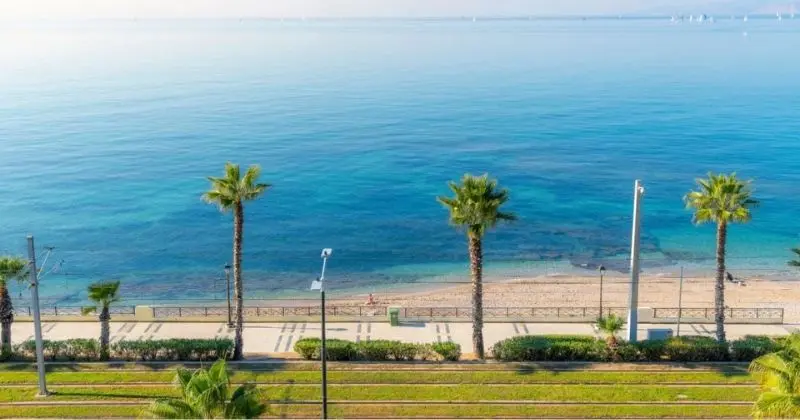
Walk along the seafront in Palaio Faliro today and you see joggers, cafés and families on the beach. It's easy to forget that this stretch of coast was once the gateway to Athens.
Phaleron, the first harbour
In antiquity the bay was called Phaleron (Φάληρον), and the name survives in today's "Faliro". Palaio Faliro simply means "Old Phaleron". The ancient port lay on the bay closest to the city, about 5 kilometres south-west of the Acropolis, and it was the main harbour of Athens before Piraeus.
Ancient writers placed famous departures here. According to tradition, Theseus sailed from Phaleron to Crete to face the Minotaur, and Menestheus led the Athenian fleet from here to Troy. Herodotus links the first port and arsenal of Athens with Phaleron.
Why Piraeus took over
Phaleron was an open, sandy bay, convenient but hard to defend. In the early 5th century BC, Themistocles pushed Athens to develop the three natural harbours of the Piraeus peninsula instead. After the Persian Wars, Piraeus became the city's naval and commercial port, and Phaleron lost its importance. The Phaleric Wall, one of the long walls that linked the coast to the city, was built to protect this side of Athens.
Traces of that early history still turn up. Excavations in the wider Faliro area have revealed ancient cemeteries, and archaeologists have reported finds that may belong to the first port itself.
The modern seaside town
Today Palaio Faliro is a town of its own within greater Athens, stretching along the east side of Phaleron Bay. Its neighbourhoods include Edem, Batis, Amfithea, Flisvos and Pikrodafni. The historic Flisvos building on Poseidonos Avenue is protected as a monument of the town's heritage and is now a municipal cultural centre.
A battleship and an Olympic coast
Since 1984, the armoured cruiser Georgios Averof has been moored at Trocadero, next to Flisvos Marina, as a floating naval museum. Built in Italy and launched in the early 20th century, it was the flagship of the Greek navy through the Balkan Wars and the World Wars. Today it's one of the most striking sights on a seafront walk.
In the run-up to the 2004 Olympics, the Faliro coast was redeveloped. Further along the bay, the Stavros Niarchos Foundation Cultural Center later added a large park, the National Library and the National Opera to this side of the city.
Seeing it for yourself
The best way to feel this history is on foot: start at Edem Beach, walk the promenade to Flisvos Marina and the Averof, and imagine the open bay where Athenian ships were once pulled up on the sand. Our Palaio Faliro guide has the details, and our apartment is a 3-minute walk from the start of that route.
Sources: Palaio Faliro Municipality (palaiofaliro.gr), Hellenic Navy (averof.hellenicnavy.gr), Princeton Encyclopedia of Classical Sites.